
DFC takes aim at sewage leaks with next-generation Vent-O-Mat RGX II air valve
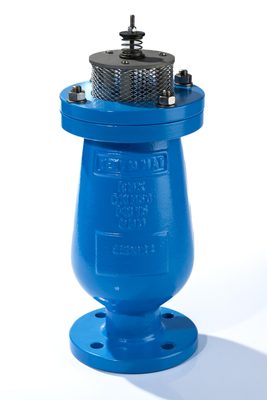
Sewage leaks rank among the wastewater industry’s biggest challenges. They can contaminate the environment, threaten public health and cause costly infrastructure damage. Often, the overlooked cause is an air valve that cannot hold an effective seal at very low pipeline pressures.
Dynamic Fluid Control (DFC) addresses this problem with the latest generation of its Vent-O-Mat RGX II air valve. The innovative float design seals at pressures as low as 0.07 bar (7 kPa) without losing its full design rating. The valve helps wastewater operators reduce leaks, protect pipelines and improve operational reliability. Operators can also upgrade existing RGX II valves to the new design.
DFC developed the valve in response to customer demand. Testing and field installations in the USA and South Africa have validated the design. The valve combines low-pressure sealing, air management, surge protection and vacuum protection in a compact, maintenance-friendly design.

Why low-pressure sealing matters
‘Very low pressures can occur in gravity-fed pipeline sections, at high points in a network, or during pump start-up and shutdown,’ he says. ‘With sewage and effluent, even small leaks can have significant operational, environmental and public health consequences.’
‘The market wanted a reliable solution that seals effectively under these conditions. That challenge led directly to the RGX II sewage air valve. In the USA, low-pressure applications commonly face a no-spill requirement, and the new design is proving particularly successful there.’
‘The market wanted a reliable solution that seals effectively under these conditions. That challenge led directly to the RGX II sewage air valve. In the USA, low-pressure applications commonly face a no-spill requirement, and the new design is proving particularly successful there.’
The tech behind the performance
Hedtrich notes that the innovation centres on a redesigned lower float that is highly buoyant and exceptionally lightweight. Unlike many conventional valves, the RGX II seals at very low pressures and at its full design rating.
Successful field installations in South Africa and the United States have confirmed the low-pressure sealing. DFC also hydrostatically tests every valve body to 1.5 times its full working pressure, whatever the rating.
Managing trapped air and gases
Beyond preventing leaks, the RGX II addresses trapped air and gases in wastewater systems. Air pockets reduce pumping efficiency. Gases from decomposing waste can also corrode concrete structures, chambers and metal components.
‘Gas occupies space that should carry fluid, reducing pumping efficiency,’ says Hedtrich. ‘Sewage-generated gases can also form highly corrosive compounds that damage infrastructure. Effective air and gas management is therefore critical to wastewater network integrity and efficiency.’
The RGX II releases air in three stages. Large volumes escape through the full bore while the pipeline fills. A reduced anti-shock orifice then cushions fast-approaching fluid, so the valve does not slam shut and cause pressure surges. A small nozzle releases gas continuously during operation. When the line drains or a vacuum forms, the floats drop to admit air and protect the pipe from collapse. This reduces pipeline stress and supports reliable operation throughout the system lifecycle.
The valve also includes practical improvements informed by customer feedback and research. Compared with the previous RGX range, the RGX II has a more compact body for height-restricted chambers, and its cage and float assembly can be removed as one unit for easier inspection and maintenance. Existing RGX II valves can be upgraded to the new low-pressure design without replacing the valve. DFC has also developed an industry-used sizing programme that consulting engineers use during pipeline design to select and position air valves correctly.
Little maintenance required
Importantly, the standard RGX II design contains no springs, reducing the number of moving parts that may be subject to wear, corrosion or clogging over time.
‘Maintenance requirements are minimal when the correct valve is selected for the application, and when servicing is needed, the entire cage and float assembly comes out through the top of the valve in a single operation. The design focuses on reliability, maintainability and long-term value,’ says Hedtrich.
Designed and manufactured in South Africa with 100% local content, the RGX II draws on DFC’s 79 years of manufacturing experience. Its new float and cage design is protected by patents in South Africa, the United States, Canada, Europe and Australia, taking local innovation to global markets.
‘South African engineering is competing successfully in some of the world’s most demanding wastewater markets. The RGX II is tested, proven in the field and patented, but most importantly it delivers value through lower risk, improved pipeline protection and a reduced total cost of ownership over the life of the asset,’ says Hedtrich. He adds that Vent-O-Mat air valves provide value over the lifetime of the project: the procurement cost is negligible compared with the protection the valve provides to the pipeline, and DFC is committed to delivering premium quality at a competitive price.
South Africa’s National Water Act and National Environmental Management Act place duties on responsible parties to take reasonable measures to prevent and remedy pollution. While no product guarantees compliance, DFC says reliable components, supported by sound design, operation and maintenance, can help operators reduce sewage-spill risks.