
The Madison, Bree Street, Cape Town: dhk Architects designs a 23-storey city landmark
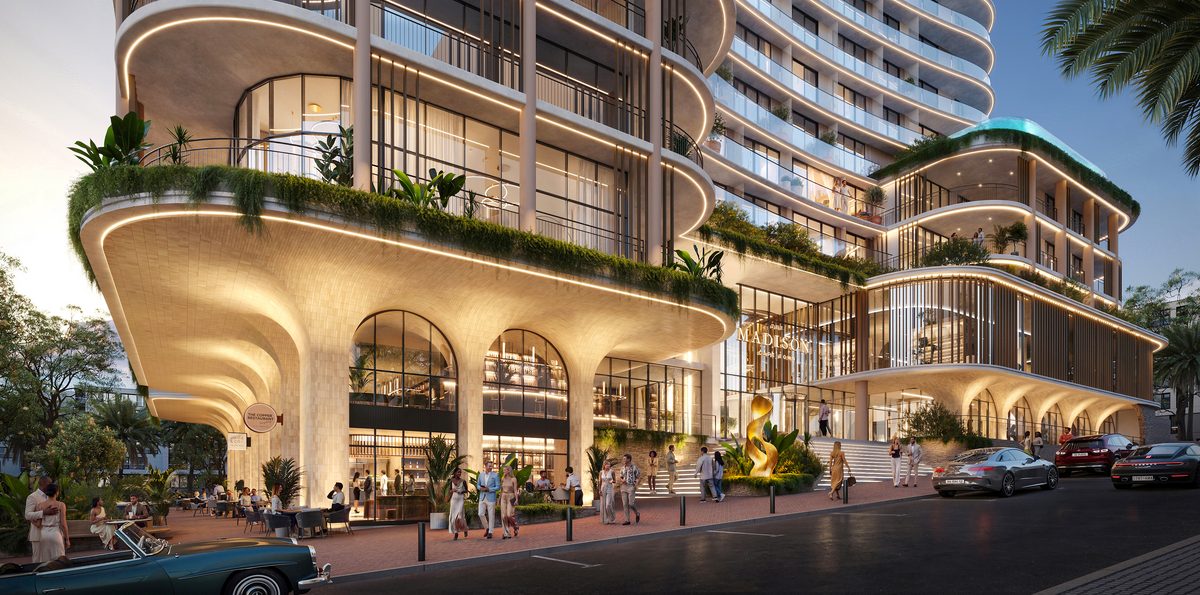
Bree Street’s transformation continues. dhk Architects has revealed designs for The Madison, a 23-storey mixed-use development that will occupy a full city block on Bree Street, Cape Town. When the project launched in July 2026, developer Tricolt secured over R1.255 billion in off-plan sales. Buyers reserved 176 apartments in the first hour alone. Four streets – Bree, Buitengracht, Dorp and Leeuwen – bound the site, which sits adjacent to the Bo-Kaap and within the Heritage Protection Overlay Zone along Strand Street. That proximity to one of Cape Town’s oldest neighbourhoods shaped the design from the outset.
A podium that respects its neighbours
The building’s massing responds directly to its surroundings. A sculpturally articulated podium sits at street level. It matches the height of nearby buildings and grounds the tower above. The tower steps back as a simplified organic form and terminates in a striking crown. Daniel Hookins, senior associate at dhk, explains the thinking.
‘Knowing that we were designing a tower above Strand Street, which sits within the Heritage Protection Overlay Zone, we had to ask how we respond to the buildings around it. The building’s massing features a sculpturally articulated podium base that enables the building to interact with the surrounding streetscape. We saw the podium as a perfect opportunity to craft a civic gesture, to ensure the building related more directly to its surrounds. It is designed to share similar heights with the buildings around it. Above it, the tower is expressed as a simplified organic form, terminating in a striking crown element.’
Life at ground level
The Madison will house 383 apartments, from one- and two-bedroom units to executive suites, simplex units and penthouses. Ground-floor retail and restaurants will line Bree Street, while the primary pedestrian entrance opens onto Dorp Street. The design will strengthen street-level activity and connectivity in a part of the city already alive with foot traffic. Openings at ground level draw people through the block rather than past it.
A proven partnership
This is the first dhk–Tricolt project in Cape Town. The two firms have collaborated extensively in Johannesburg on Olympus Sandton, One Rosebank, Tree Tops Houghton and Ellipse Waterfall. The partnership pairs Tricolt’s residential development expertise with dhk’s deep familiarity with Cape Town’s urban fabric. dhk has shaped the city for nearly three decades. Derick Henstra Architects and KCvR Architects merged in 1998 to form the practice, which has delivered projects including Portside, 35 Lower Long, The Rubik and the Longkloof Precinct. Today dhk is part of 10N, a collective Egis created, with studios in Cape Town and Johannesburg and a team of more than 140.
Building momentum on Bree Street
Just three blocks away, dhk is also working on City Park | MAMA Shelter Cape Town, an adaptive reuse project due for completion by year end. Other nearby projects – The Paradigm and The Matrix – are at various stages of development. Hookins sees the two projects as complementary.
‘When we were appointed to work on City Park | MAMA Shelter Cape Town, I thought it would be a once-in-a-lifetime opportunity to work on a large project occupying an entire city block in such an incredible location. Now, just three blocks away, we have another opportunity to shape a significant piece of the city. The difference between the two projects is that City Park is an adaptive reuse project with its own challenges, while The Madison is a new-build development with its own character and complexities. Both projects, however, are about contributing meaningfully to the future of Cape Town’s urban environment.’
Looking ahead
With 72% of apartments already sold – surpassing the threshold needed to break ground – Tricolt will begin construction in early 2027. The developer expects practical completion in mid-2029. The Madison joins a broader pattern of regeneration reshaping this corner of the CBD. It links the energy of Bree Street to the heritage of the Bo-Kaap and, in doing so, asks how a city grows without losing what makes it distinctive.